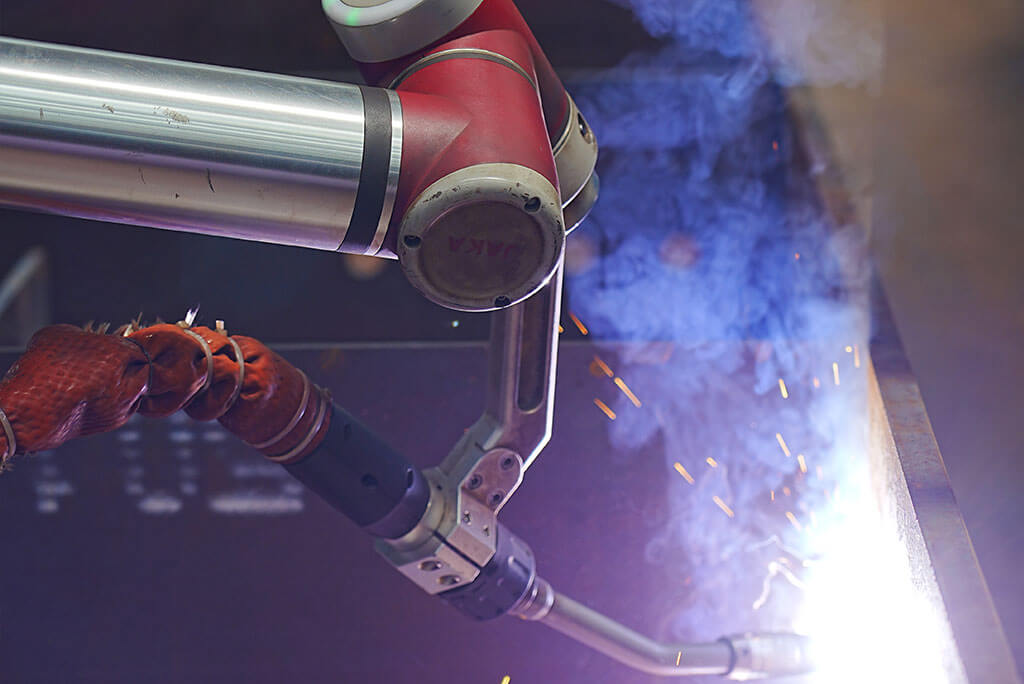
As we move through 2026, the debate in factory boardrooms has shifted from whether to automate to which kind of automation is most effective. For decades, the high-speed, high-power traditional industrial robot was the only choice. However, the rapid rise of the industrial cobot—or collaborative robot—has introduced a new level of agility that is challenging the old guard.
So, which is better? The answer depends entirely on your production goals. While traditional systems prioritize raw speed, an industrial collaborative robot focuses on flexibility, safety, and a much faster return on investment (ROI). Below, we break down the key differences to help you decide which system fits your facility’s future.
1. Safety and Workspace Integration
The most visible difference between these two systems is the “cage.”
Traditional Robots: These are high-speed, high-force machines. Due to the momentum they carry, any contact with a human would be catastrophic. Consequently, they require extensive safety fencing, light curtains, and interlocked gates, which drastically increases the physical footprint of the automation cell.
Industrial Collaborative Robots: Designed with safety “baked in,” these robots utilize advanced force-limiting sensors. If an industrial cobot detects an unexpected touch or obstacle, it stops instantly. This allows them to work directly alongside human operators without bulky barriers, reclaiming valuable floor space and allowing for a more fluid, integrated production line.
2. Deployment Speed and Ease of Programming
In a world where product life cycles are shrinking, the time it takes to set up a robot is a critical metric.
Traditional Robots: These systems often require specialized robotic engineers and weeks of complex coding. Moving a traditional robot to a new task is a major project that often requires a complete overhaul of the safety infrastructure and PLC logic.
Industrial Collaborative Robots: Cobots are built for the “citizen programmer.” Most feature intuitive, graphical interfaces or “hand-guide” teaching, where an operator simply moves the robot arm through the desired path. This means an industrial cobot can often be unboxed and productive within a single afternoon, making it the superior choice for high-mix, low-volume production.
3. Speed vs. Versatility
This is where the trade-off becomes most apparent.
Traditional Robots: If your goal is to move 60 parts per minute in a 24/7 high-volume environment where humans never need to enter, a traditional robot is the “speed king.” They are built for maximum throughput and can handle payloads exceeding 1,000 kg.
Industrial Collaborative Robots: While modern cobots are significantly faster than their predecessors, they are generally capped at lower speeds when humans are present to ensure safety. Their strength lies in versatility—the ability to be moved from a screwdriving station in the morning to a packaging line in the afternoon.
4. Total Cost of Ownership (TCO)
While the “sticker price” of a traditional robot might sometimes seem lower, the total cost of deployment often tells a different story.
Traditional Robots: You must factor in the cost of safety cages, specialized integration services, and the permanent loss of floor space.
Industrial Collaborative Robots: Because they require minimal guarding and can be programmed by existing staff, the integration costs are substantially lower. In many B2B manufacturing scenarios, an industrial cobot pays for itself in under 12 months, compared to the 2–3 year window typical for traditional industrial systems.
The Pro-Grade Solution: When to Choose the JAKA Pro Series
In the past, the main argument against the industrial collaborative robot was that it wasn’t “tough” enough for heavy industrial use. Standard cobots often struggled in environments with oil mist, metal shavings, or extreme temperatures.
The JAKA Pro series was engineered specifically to solve this problem, effectively bridging the gap between collaborative flexibility and traditional industrial durability.
Why the JAKA Pro Series is the Best of Both Worlds
Industrial Resilience: Featuring an IP68 rating, the JAKA Pro is completely dust-tight and can withstand high-pressure washdowns or immersion. It thrives in the harsh CNC tending and welding environments where traditional robots used to be the only option.
Safety Without Compromise: It maintains all the safety protocols of an industrial collaborative robot, including sensitive collision detection, but with the high-performance motors required for 24/7 industrial duty cycles.
Precision and Power: With a repeatability of ±0.02 mm and payload options up to 16kg, the JAKA Pro series offers the precision of a traditional system with the easy-to-use graphical programming that defines the JAKA ecosystem.
Longevity: Built with high-grade industrial components, the JAKA Pro series boasts a long Mean Time Between Failure (MTBF) , ensuring it can handle the workload of a traditional system while remaining easy to redeploy.
If your factory requires the ruggedness of a traditional system but the flexibility and safety of an industrial cobot, the JAKA Pro series is the definitive answer for 2026.
Conclusion
In 2026, the choice between an industrial cobot and traditional systems depends on your need for speed versus agility. While traditional robots dominate high-volume, isolated tasks, industrial collaborative robots empower modern factories through fenceless integration and rapid redeployability.
For harsh environments, the JAKA series like JAKA Pro12 offers a powerful middle ground. Featuring an IP68 rating and ±0.03mm repeatability, it handles oil and dust while maintaining collaborative safety. With payloads up to 16kg and intuitive graphical programming, the JAKA Pro proves you can achieve industrial-grade “toughness” without sacrificing the flexibility and fast ROI of a collaborative partner.
