Battery energy storage systems are becoming an important part of modern power infrastructure, supporting renewable energy integration, peak shaving, backup power, and more flexible energy management. As battery capacity and system voltage increase, however, electrical protection becomes more important. Selecting suitable electrical control products is essential for managing abnormal current, short circuits, overloads, and transient overvoltage within the DC side of an energy storage system.
Unlike AC circuits, DC circuits do not naturally pass through zero current during each cycle. This makes DC fault interruption more demanding and means that protection devices must be specifically designed for DC applications. For system designers, installers, and equipment manufacturers, the right protection strategy starts with understanding the operating conditions and selecting components that match the actual electrical requirements.
Why DC Protection Requires Careful Selection
The battery side of an energy storage system can deliver substantial fault current. If a short circuit or overload occurs, the resulting current can quickly stress cables, busbars, battery modules, inverters, and other components.
A suitable DC circuit breaker provides a controlled method of interrupting abnormal current. Its DC-rated breaking capability, voltage rating, current rating, and installation configuration all need to correspond to the system.
Protection should not be selected simply according to the normal operating current. Engineers also need to consider the prospective short-circuit current, maximum DC voltage, ambient temperature, cable characteristics, and coordination with other protection components.
For this reason, DC protection is normally treated as part of the overall system design rather than as an isolated component choice.
Choosing Between DC MCB and DC MCCB
Different parts of an energy storage system can have very different current requirements. A DC MCB is generally suited to smaller DC circuits where compact protection and straightforward installation are important. It can be used in applications such as battery branches, control circuits, and other relatively lower-current DC circuits.
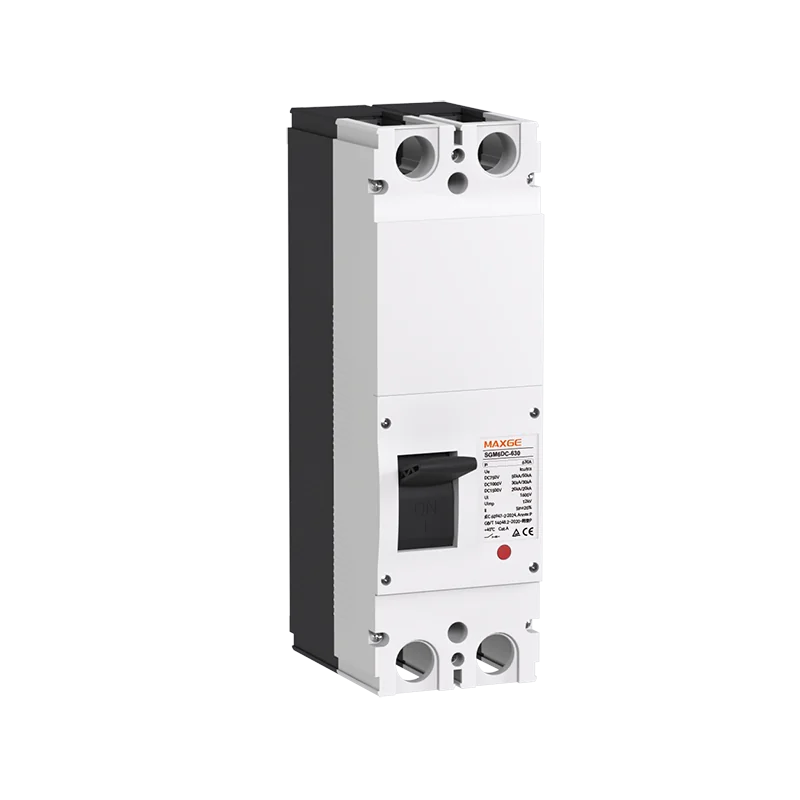
For higher-current applications, a DC MCCB can provide a more suitable solution. MAXGE offers DC MCCB products intended for medium and large DC circuits, including applications associated with photovoltaic systems and energy storage. Its product range includes the SGM6-630DC and SGM6-630HU models.
The selection should be based on the actual voltage and current requirements rather than simply choosing the breaker with the highest available rating. Oversizing can reduce the effectiveness of protection, while undersizing may result in unnecessary trips during normal operation.
Building a Complete DC Protection Strategy
A circuit breaker is only one part of a comprehensive protection system. Battery energy storage installations may also require surge protection and overcurrent protection depending on the system architecture and operating environment.
MAXGE’s new energy solutions address protection requirements across DC circuits used in applications such as photovoltaic generation and energy storage. In these systems, protection needs can vary between PV strings, DC distribution sections, battery-side circuits, and other high-current DC paths. MAXGE provides corresponding solutions for switching, isolation, overcurrent, and surge protection, including DC MCBs, DC MCCBs, DC ACB isolators, and DC SPD and fuse products. This application-oriented approach allows protection devices to be selected according to circuit voltage, current, fault conditions, and the specific configuration of the new energy system.
This approach allows protection to be considered across different sections of the DC system. Overcurrent protection addresses abnormal current conditions, while surge protection helps manage transient voltage events. Where maintenance isolation is required, a suitable DC isolator can provide a visible separation point.
The objective is not simply to add more protective components, but to establish appropriate protection at each relevant point of the electrical architecture.
Key Parameters to Check Before Selection
Before purchasing electrical control products for an energy storage project, several technical parameters should be reviewed carefully.
The first is the maximum system voltage. The selected device must have a DC voltage rating appropriate for the actual circuit, including the highest expected operating voltage.
The second is the rated current. This should reflect the continuous operating current while allowing for the characteristics of the connected load and system design.
Breaking capacity is another critical consideration. A protective device must be capable of safely interrupting the prospective fault current at its specified voltage. This is particularly important for battery systems because their available fault current can be significant.
Environmental conditions should also be evaluated. Temperature, enclosure conditions, installation method, and altitude can affect equipment performance and should be considered alongside the manufacturer’s technical documentation.
Finally, protection coordination matters. The relationship between upstream and downstream devices should be assessed so that a fault can be isolated at the appropriate point without unnecessarily disconnecting the entire system.
Why Product Documentation Matters
For technical projects, product selection should be supported by clear specifications rather than marketing descriptions alone. Engineers should review rated voltage, rated current, breaking capacity, applicable standards, connection requirements, and installation information before finalizing a design.
MAXGE provides a broad range of electrical products, including MCB, RCCB, RCBO, MCCB, ACB, new energy devices, smart breakers, distribution boxes, and industrial devices. Its product center also provides access to technical support and product documentation.
This broader product range can be useful when a project requires different protection and control components across AC and DC sections. Instead of treating each device independently, the complete distribution and protection architecture can be evaluated as one system.
Making DC Protection Part of the Design Process
Battery energy storage safety depends on more than selecting a single circuit breaker. The protection system needs to correspond with battery characteristics, system voltage, fault current, cabling, switching requirements, and the surrounding electrical equipment.
For projects requiring DC circuit breakers, DC MCCBs, surge protection, or other electrical control products, MAXGE provides a dedicated new energy product range covering several DC protection requirements.
For product specifications, application requirements, or protection selection, you can contact MAXGE through its official contact page. Supported by smart manufacturing and automated production lines across its Deqing and Wuhu manufacturing bases, MAXGE combines more than 90% automation with an experienced R&D team, patented technologies, software copyrights, CNAS-related laboratory capabilities, and international certifications. Its portfolio covers a broad range of low-voltage electrical products, as well as electrical protection solutions for renewable energy, PV, energy storage, and EV charging applications.
With a market presence spanning more than 60 countries and over 80 distribution partners, MAXGE serves customers through a brand portfolio that includes MAXGE, EMA, and GEBLER. Through a customer-focused approach, continued investment in innovation, and long-term cooperation with partners, MAXGE supports diverse electrical protection requirements across different markets and application environments.
