Selective laser melting (SLM) is well suited for producing complex, customized metal components. However, its suitability depends on part geometry, material properties, operating conditions, and production volume.
Understanding these factors helps engineering teams evaluate metal additive manufacturing solutions and avoid unnecessary costs. By comparing material requirements, part complexity, production volume, and post-processing needs, manufacturers can select a suitable workflow that meets their technical goals and budget.
How SLM Determines Part Suitability
SLM is a powder-bed fusion process. A laser selectively melts metal powder according to a digital model, building a component layer by layer. Additional powder is spread across the build area after each layer until the part reaches its intended shape.
This process can produce features that are difficult or expensive to manufacture through conventional machining alone. Examples include internal passages, lattice structures, thin walls, and components that combine several functions.
However, design freedom does not eliminate engineering constraints. Support structures, powder removal, thermal distortion, dimensional tolerances, and surface finishing must be considered during design. SLM is most suitable when its functional benefits justify these additional requirements.
Complex Cooling Channels and Customized Mold Inserts
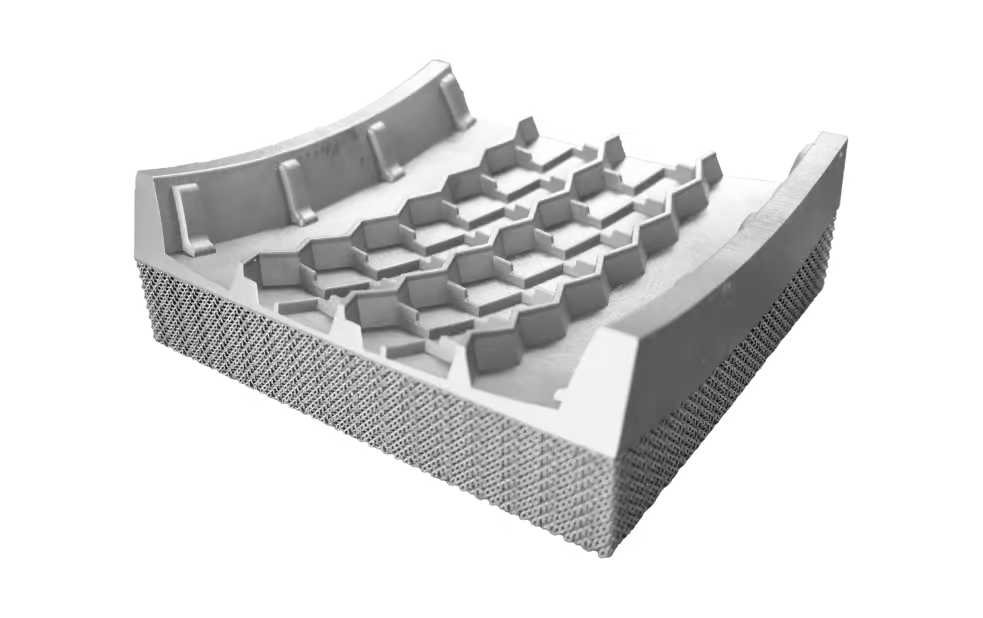
Mold inserts are strong candidates for SLM because their performance often depends on internal geometries that conventional drilling cannot easily produce. Conformal cooling channels can follow the contours of a mold cavity, helping distribute heat more evenly than some conventional channel layouts.
This approach is relevant to injection molding, die-casting tools, and footwear molds. Better temperature management may reduce localized hot spots and shorten production cycles, depending on the mold design, coolant flow, material, and operating conditions. Integrated features can also reduce the need for separate components and complicated assemblies.
Before printing, engineers should evaluate channel dimensions, wall thickness, support requirements, and powder evacuation routes. Internal passages must be accessible for cleaning and inspection. Otherwise, residual powder or inaccessible areas may compromise component quality.
The economic case depends on tooling complexity, production volume, maintenance requirements, and expected cycle-time improvements. Simple inserts may remain more economical to machine conventionally. SLM becomes more attractive when customized geometry solves a measurable manufacturing problem.
Lightweight Structural Components
Aerospace equipment, robotics, and industrial automation often require components that balance strength, stiffness, and weight. SLM supports topology-optimized designs, hollow sections, and lattice structures that can reduce material use while retaining material in critical load-bearing areas.
Potential applications include brackets, mounting structures, selected housings, and specialized structural components. Integrating several features into one part may also reduce fasteners, interfaces, and assembly work.
Lightweight design requires more than removing material from a conventional model. Engineers must evaluate load paths, fatigue behavior, vibration, heat exposure, and build orientation. Printed components may require heat treatment, machining, or additional finishing to meet dimensional and performance requirements.
For safety-critical applications, testing and qualification remain essential. A complex geometry alone does not establish that a part is suitable for service.
Heat Exchangers and Fluid-Handling Components
Heat exchangers, manifolds, and selected fluid-handling components can benefit from SLM when compact dimensions and intricate internal structures are important. Engineers can design branching passages and integrated channels that would be difficult to produce using conventional manufacturing methods.
These components may serve energy systems, thermal management equipment, and specialized industrial machinery. Their suitability depends on operating pressure, temperature, corrosion exposure, flow resistance, and cleaning requirements.
Internal surface roughness can influence pressure drop and flow performance. Incomplete powder removal may also create contamination or blockage risks. Design reviews should therefore address powder evacuation, inspection access, pressure testing, and post-processing before production begins.
Material Selection and Manufacturing Requirements
Material selection must reflect the component’s operating environment rather than printability alone. Metal powder options include aluminum alloys, titanium alloys, stainless steels, cobalt-chromium alloys, and nickel-based superalloys. Each offers different combinations of density, strength, corrosion resistance, thermal behavior, and cost.
Aluminum alloys suit lightweight and thermal components, titanium alloys offer high strength-to-weight ratios, and stainless steels provide corrosion resistance. Tool steels are suitable for mold inserts, while nickel-based superalloys perform well in high-temperature environments. Final material selection depends on the alloy grade and verified mechanical properties.
When evaluating SLM additive manufacturing, engineering and procurement teams should also review build-envelope limits, dimensional tolerances, surface-finish requirements, powder handling, post-processing, and inspection procedures. Capabilities depend on the machine, material, and process parameters selected.
SLM is not automatically the lowest-cost option for every production run. Conventional machining, casting, or fabrication may remain more economical for simple geometries or high-volume production. A sound comparison should consider the complete manufacturing route, including tooling, assembly, material waste, finishing, and expected service performance.
How to Assess a Part Before Requesting a Quote
Before requesting a quote, manufacturers should provide a 3D CAD model, material specifications, key dimensions, operating conditions, and production volume. LiMN 3D offers metal additive manufacturing equipment and customized printing services to help assess design feasibility and post-processing needs.
