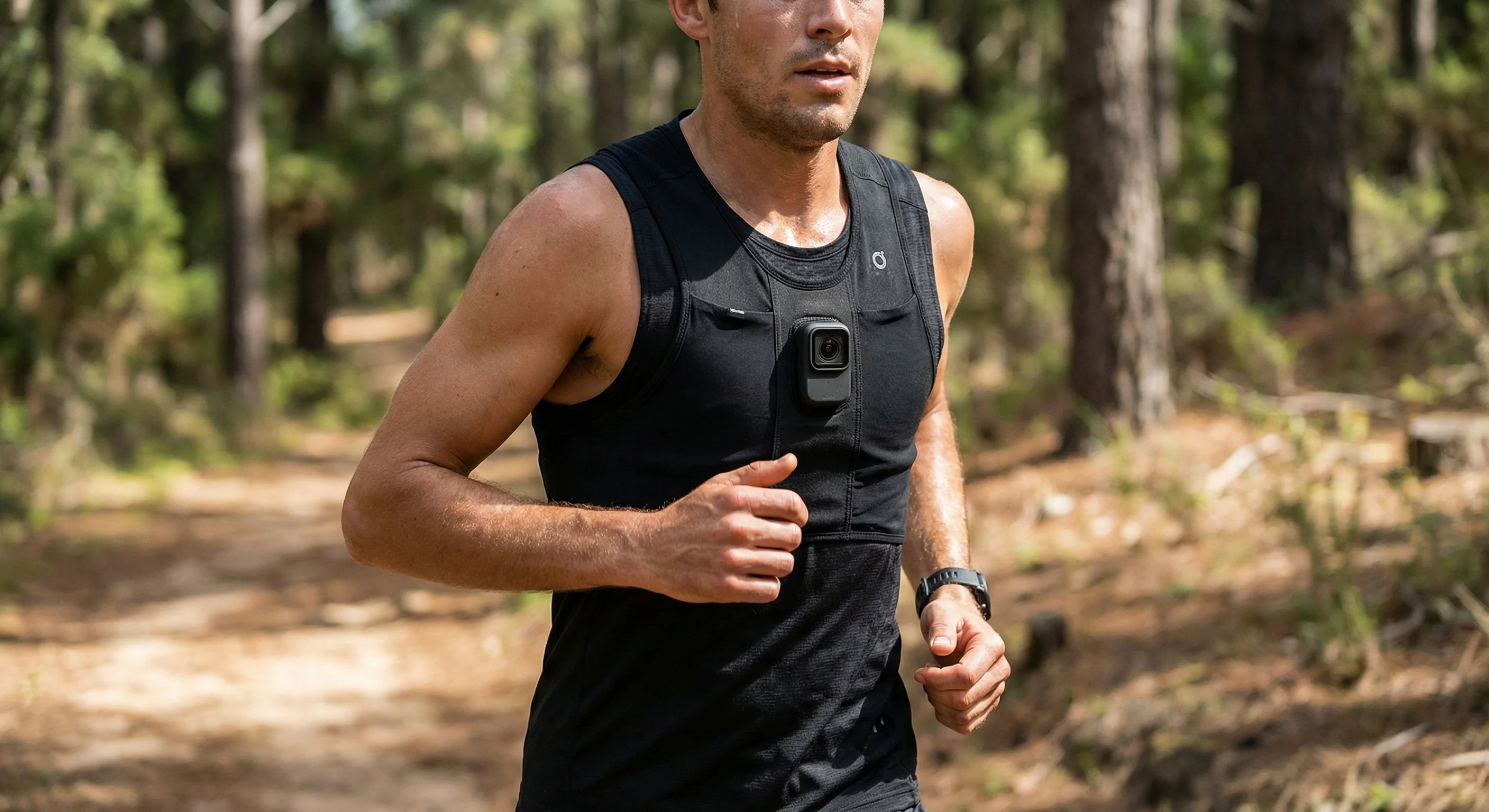
Smart sports wearables combine electronics with a physical environment that is unusually demanding. The product moves with the body, may be exposed to sweat and repeated impact, must remain light enough for active use, and often depends on sensors, cameras, wireless links, or batteries that need stable placement.
Manufacturing strategy therefore starts with system architecture rather than factory capacity alone. Hardware, firmware, textile or enclosure mechanics, sourcing, validation, and production ownership have to be coordinated so that a prototype that performs well under controlled testing can still be assembled consistently after the design moves into small batches and volume production.
Sports Wearables Create Cross-Disciplinary Design Constraints
The core design problem is coordination across motion, comfort, sensing, and electronics. A manufacturing agent ODM China program has to keep those physical and electronic requirements connected. That coordination is where manufacturing partnerships become valuable, because both sides can work from the same product assumptions.
A camera or sensor cannot be designed independently of garment flex, mounting stiffness, user motion, battery position, and cable or board protection. The mechanical structure influences data quality and durability just as strongly as the electronic specification. Power and weight form another trade-off. Larger batteries can extend runtime but increase mass and volume; more processing capability can support richer functions but raise energy and thermal demands.
Motion also changes verification because an assembly that works on a bench may behave differently when it is repeatedly accelerated, bent, or exposed to perspiration. The product architecture needs test conditions that represent actual sports use because static electrical checks cannot reproduce those loads.
Sensor and camera placement adds a further mechanical problem: the location that captures the best signal may be the location most exposed to motion, impact, or user contact. Engineering has to balance measurement quality with protection, serviceability, and comfort instead of optimizing the sensing element in isolation.
ODM, JDM, and OEM Define Who Owns the Missing Work
Wearable programs expose the cooperation model through the technical work that is still unfinished. Under a manufacturing agent ODM China arrangement, manufacturing partnerships may be build-to-print, jointly developed, or supplier-led depending on which technical work is still unresolved.
Minewing’s JDM/OEM/ODM model uses OEM for finalized designs that mainly need manufacturing, ODM for customers with a product idea that requires hardware development, and JDM for programs in which the customer holds key technology or requirements while additional engineering is completed jointly. That distinction is especially relevant to wearables because the product may combine proprietary algorithms with externally developed electronics and mechanics.
A brand can retain software or core technology while a manufacturing partner handles PCB development, firmware interfaces, structural design, sourcing, prototyping, or production engineering. Written responsibility boundaries reduce gaps such as assuming that neither party owns sensor calibration, battery qualification, garment integration, or final test design.
Prototype the Wearable as a Complete Moving System
A wearable prototype has to reproduce the interactions that matter in motion, not just prove the electronics on a bench. Within a manufacturing agent ODM China project, those prototypes establish what manufacturing partnerships will later have to reproduce at scale.
Minewing’s smart sports vest combined a lightweight stabilized high-definition camera with an ergonomic garment for runners, cyclists, hikers, and other outdoor users. Inside the flexible textile structure, mechanical supports had to work together with custom PCB hardware and stabilization and image-processing firmware, while optical sensors and battery components were sourced for the same integrated design.
Functional prototypes were used for rapid design validation, and hardware and software were optimized for stable recording during heavy motion. After that prototype work, the program entered small-batch trials that tested whether the sweat-resistant wearable design could be reproduced under production conditions before mass production was authorized.
That sequence demonstrates why a prototype should test the whole moving system. Camera stabilization depends on mechanical support and firmware; battery performance depends on electrical load and physical packaging; sweat resistance depends on structures, materials, openings, and assembly quality.
Manufacturing Infrastructure Determines How the Program Scales
Scale-up begins with the resources required by the validated design. A manufacturing agent ODM China arrangement therefore depends on production infrastructure. The same scale-up path also places sourcing, certification support, and logistics within manufacturing partnerships.
Minewing‘s integrated route includes PCBA layout and firmware, DFM cost optimization, rapid prototyping with a 48-hour capability, high-precision SMT and DIP, custom tooling and molding, component sourcing, CE/FCC-related quality and certification support, and global logistics and delivery.
Project requirements can be evaluated after inquiry, with an actionable plan available within 24 hours. Minewing uses its two manufacturing bases for different stages of the program: China concentrates on R&D, engineering, and precision assembly, while Vietnam provides a route for scalable mass production and tariff mitigation.
For a sports-wearable program, this structure separates neither engineering nor production from supply-chain planning. The scale-up route has to preserve the same PCB, firmware, optical, battery, mechanical, and quality assumptions that were proven in prototypes, even when volume or production location changes.
A smart sports wearable reaches mass production only when its cross-disciplinary constraints are managed as one program. Motion, sweat, weight, power, sensing, firmware, garment mechanics, and assembly cannot be optimized independently because each affects the others.
The choice among OEM, ODM, and JDM then determines who is responsible for solving the remaining technical work. Minewing’s sports-vest case illustrates how engineering ownership carries through prototype validation, small-batch trials, and scale-up while electronics, mechanics, firmware, and sourcing remain coordinated.
The most suitable manufacturing relationship preserves those connections from engineering ownership through repeatable production; reducing the wearable to an ordinary PCB-in-fabric problem would miss the interactions that control its performance. Where sensing depends on how electronics are worn and moved, preserving those engineering connections becomes a direct condition of measurement consistency.
