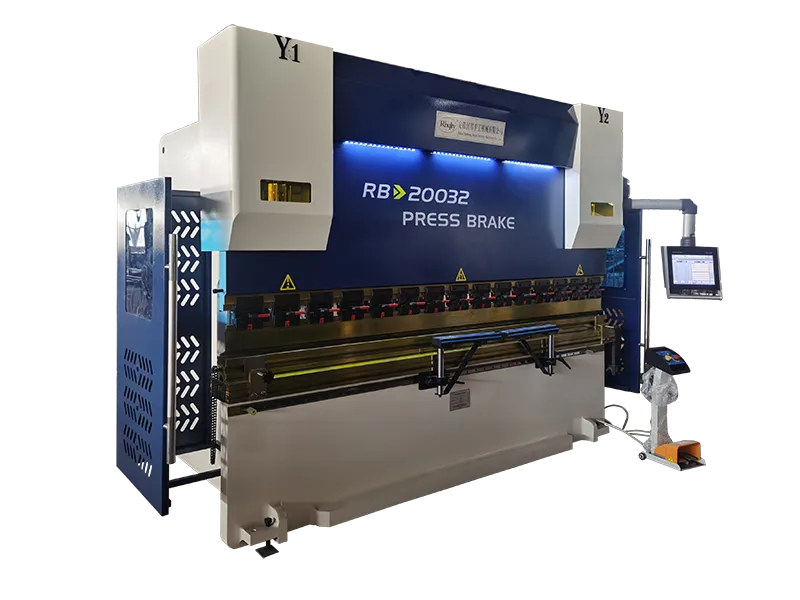
In sheet metal manufacturing, cycle time directly affects production capacity, labor efficiency, and delivery schedules. Every press brake operation involves several stages, including ram approach, bending, ram return, and material repositioning. Reducing delays between these stages can help manufacturers increase output without compromising bending quality.
Servo drive technology improves motor control and adjusts power delivery according to operating demands. However, its effect on cycle time depends on the machine design, bending requirements, and production workflow. Understanding these factors helps manufacturers choose equipment that meets their operational needs.
How Servo Drives Improve Press Brake Cycle Times
Traditional hydraulic press brakes use motor-driven pumps to supply hydraulic power. In systems with fixed-speed motors, the motor may continue running even when full output is unnecessary. Servo-driven hydraulic systems can adjust motor speed and pump output according to demand, potentially reducing wasted energy and unnecessary operation.
Servo technology can influence productivity in several ways.
Faster movement and transitions: A press brake must move the ram toward the workpiece, complete the bend, and return to its starting position. Servo control allows the drive system to respond to changing operating requirements. Depending on the machine configuration, this can improve movement transitions and reduce delays between bending operations.
Improved positioning consistency: Accurate ram positioning helps maintain repeatable bending results. When combined with suitable CNC controls and feedback systems, servo technology can reduce positioning errors and the need for repeated adjustments. This is particularly valuable when manufacturing components with multiple bends or tight dimensional tolerances.
More efficient axis coordination: The back gauge positions sheet metal before each bend. Coordinating ram movement with back-gauge positioning can reduce waiting time between operations. Servo-driven back-gauge axes support precise positioning, although programming quality, material handling, and operator experience also affect overall productivity.
Servo Electric Press Brake vs. Servo-Hydraulic Press Brake
Understanding the difference between these technologies is essential when selecting a press brake for industrial production.
A servo electric press brake uses electric servo motors and mechanical transmission components to control ram movement. Because it does not rely on conventional hydraulics to generate bending force, it can reduce hydraulic maintenance requirements. Its suitability depends on the required bending force, material thickness, and production volume.
A servo-hydraulic press brake uses servo motors to control hydraulic pumps or related hydraulic functions. This arrangement combines hydraulic bending force with demand-based motor control. It can suit manufacturers processing different sheet thicknesses and handling varied production requirements.
Neither design is automatically faster in every application. Buyers should compare approach speed, working speed under load, return speed, positioning time, and the complete cycle for representative workpieces.
What Else Affects Press Brake Productivity?
Servo drives are only one factor in bending efficiency. Other production considerations can have an equally significant impact.
CNC programming: Stored programs and automated bending-sequence calculations reduce repetitive setup work. Offline programming can also help manufacturers prepare jobs before production begins.
Tooling and changeovers: Appropriate punches and dies improve bending consistency. Quick-clamping systems can reduce setup time when operators switch between different components.
Material handling: Loading, supporting, rotating, and unloading sheets can consume substantial time. For large or heavy workpieces, sheet supports and automation may improve productivity more than increasing ram speed alone.
Maintenance: Regular inspections of drive components, positioning systems, tooling, and hydraulic components where applicable help maintain reliable performance. Servo-hydraulic systems may also reduce unnecessary energy consumption and heat generation through demand-based operation.
To measure productivity accurately, manufacturers should record the time required to complete an entire part. This includes setup, loading, bending, repositioning, inspection, and unloading, rather than focusing exclusively on maximum machine speed.
RBQLTY Press Brake Solutions for Industrial Manufacturers
RBQLTY integrates research and development, manufacturing, sales, and service for sheet metal processing equipment. They serve industries including automotive manufacturing, aerospace, shipbuilding, engineering machinery, and steel metallurgy.
Its press brake product range includes CNC electro-hydraulic press brakes, NC torsion-bar models, and machines with different bending capacities, working lengths, and control configurations. The company also provides OEM and ODM manufacturing, allowing customized production according to customer requirements.
RBQLTY’s published DA66T 6+1-axis CNC press brake information describes a hybrid electric-hydraulic drive system and identifies fast cycling and energy efficiency as product benefits. Buyers should confirm the expected cycle time and energy consumption for their specific configuration and workpieces with the supplier. Actual performance depends on the selected configuration, workpiece specifications, and operating conditions.
For B2B buyers, RBQLTY’s equipment range provides options to evaluate according to bending force, component dimensions, control requirements, and production volume. Before purchasing, manufacturers should confirm the exact model specifications, available servo functions, axis configuration, and cycle-time performance with the supplier.
How to Choose the Right Press Brake
Servo drives can improve movement control and contribute to shorter production cycles when properly matched to the application. However, the best investment depends on the complete production process, not a single speed specification.
Before selecting a machine, define the required bending force, material thickness, workpiece dimensions, number of bends, and expected output. Request demonstrations using representative components and compare cycle time, positioning repeatability, energy consumption, setup requirements, and maintenance support.
For industrial manufacturers, this evaluation provides a more reliable basis for equipment investment. The right press brake should deliver consistent bending quality, integrate with the existing workflow, and support dependable long-term production.
