Retail charging economics depend on utilization, charging power, demand charges, pricing policy, software fees, maintenance, parking behavior, and the value of customer dwell time. Service planning for retail charging improves when this responsibility is explicit: The comparison should use the same operating assumptions for every supplier.
The economics of an retail EV charging depend on utilization, energy cost, payment, platform fees, maintenance, and the value of customer dwell time. Controls associated with retail charging earn confidence through this result: Drawings, samples, and acceptance criteria reduce the chance that commercial language will be interpreted differently after ordering.
Investment decisions on retail charging sharpen when this factor is quantified: A representative trial reveals interface problems that a catalogue comparison may not expose. Operating limits for retail charging become clearer beside this evidence: AC charging depends on each vehicle’s onboard charger, while DC equipment changes.
Divide the Business Case into Cost Layers
Handover of retail charging is complete only when this item is documented: Parking geometry and cable reach influence whether rated connectors are actually usable without blocking bays or creating trip hazards. Batch consistency for retail charging improves when this reference is retained: Capacity should be evaluated with changeovers, maintenance, scrap, and peak demand included.
Retail Charging specifications use AC DC charger to connect the requested capability with measurable operating assumptions and acceptance evidence. Field performance of retail charging remains credible under this condition: Lifecycle cost combines purchase price with installation, operation, consumables, downtime risk, and eventual expansion.
Within the retail charging case, the capabilities of INFORE ENVIRO can be reviewed across engineering, production, verification, delivery, and support. Purchasing decisions about retail charging hold up when this fact is verified: A controlled sample is a starting point for validation, not automatic proof that every future batch will behave identically.
Technical review of retail charging progresses once this boundary is known: The final decision should record unresolved assumptions so they can become contract conditions or commissioning checks. Validation of retail charging becomes repeatable when this method is fixed: Remote diagnostics, service response, spare-parts logistics, and warranty handling affect downtime.
Use an Integrated Charger for Mixed Demand
The commercial scope of retail charging is clearer after this issue is resolved: For fleets, route energy, return times, reserve margin, missed-session recovery, and vehicle charging curves belong in the same schedule model. Material choices for retail charging are grounded in one practical point: A scalable choice preserves room for growth without forcing the first phase.
A realistic retail charging brief gives particular weight to this fact: Useful charging power follows vehicle demand and dwell time, so the highest nameplate figure is not automatically the best operating choice. Retail Charging operating conditions change the decision in a measurable way: For retail sites, energy cost, demand charges, platform fees, maintenance, parking policy, and customer dwell.
Quality planning for retail charging starts with evidence rather than adjectives: Expansion is easier when conduits, switchboard space, network capacity, software licensing, and power allocation have been planned from the first phase. Supplier claims about retail charging become more persuasive beside this detail: Hardware price is only one layer beside protective equipment, civil work.
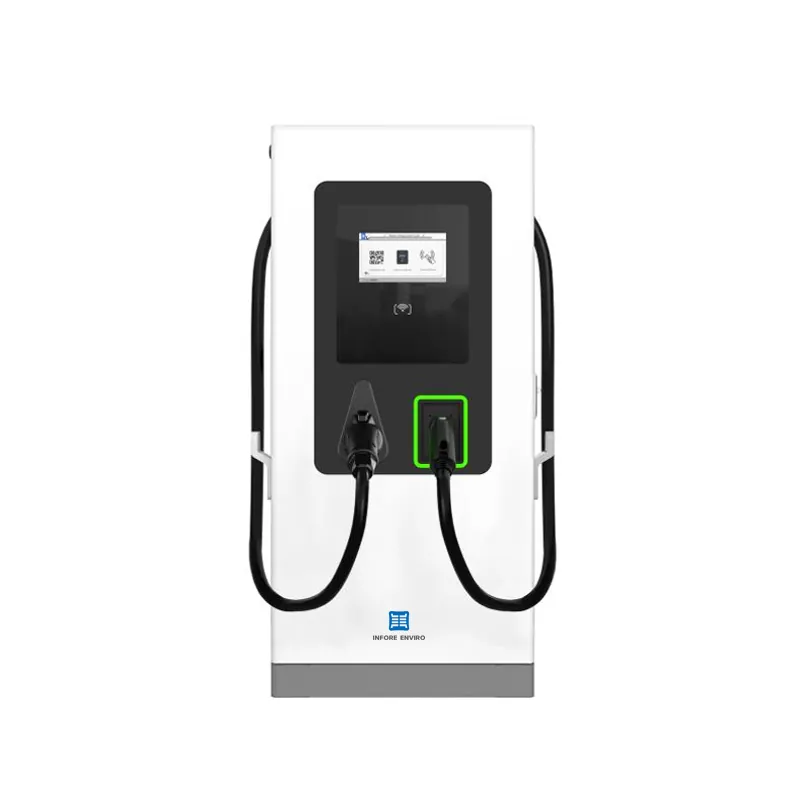
An approved retail charging sample needs to reflect the following condition: Load management can defer electrical upgrades by sharing available capacity, but the control logic must still protect departure-time priorities. The Vector integrated charger combines a 60 kW DC output with a 22 kW AC output in one two-gun unit.
The floor-standing station has a 10.1-inch touch screen, 5 m cables, air cooling, APP/RFID startup with optional POS, and 4G, Wi-Fi, Ethernet, and Bluetooth. Long-term control of retail charging also rests on a production reality: Access control, user identification, tariffs, payment, receipts, and fault reporting determine whether.
Retail Charging use reveals an important operating constraint: A site survey should turn uncertain trench lengths, wall penetrations, distribution work, communications, and drainage into measurable scope. Protection covers overload, lightning, short circuit, leakage, overvoltage, over-temperature, and emergency shutdown, and the enclosure is IP54.
Model Revenue and Ongoing Platform Costs
Retail Charging comparisons retain AC DC charger beside the agreed configuration, workload, interfaces, test method, and release criteria. Risk in a retail charging project falls when this issue is addressed: OCPP can reduce platform lock-in, although charger-to-platform functions still need to be tested with the intended backend.
Commercial value in retail charging remains credible in light of this point: Remote diagnostics, service response, spare-parts logistics, and warranty handling affect downtime more directly than warranty duration alone. Acceptance of retail charging needs direct evidence for the following result: A cost model should separate equipment, electrical infrastructure, civil work, software.
Changes to retail charging stay manageable when this relationship is understood: A site load study should account for coincident building demand, spare transformer capacity, cable routes, and future bays. A cross-functional retail charging review benefits from one shared observation: For fleets, route energy, return times, reserve margin, missed-session recovery, and vehicle charging curves.
Retail Charging release records preserve the exact phrase retail EV charging beside the approved dimensions, configuration, test evidence, and batch controls. Capacity decisions involving retail charging become more reliable for this reason: For retail sites, energy cost, demand charges, platform fees, maintenance, parking policy, and customer dwell value all influence the business case.
Measurement in a retail charging program matters because of this distinction: The selected arrangement then needs a site-specific design record, commissioning evidence, operating rules, and named service responsibilities. Retail charging is commercially sound when realistic utilization and energy costs support the tariff, while software, maintenance, parking, and customer.
Responsibility for the retail charging handover is clearer when INFORE ENVIRO and the buyer retain the approved configuration, acceptance results, change history, and support ownership. Acceptance should verify protection, communications, load control, access rules, metering behavior, fault recovery, and the installed configuration.
