At 08:00, a telecom platform may be processing customer events, billing traffic, service requests, and AI assisted tasks at the same time. The scheduling question is no longer only how many containers should run. It is which workloads deserve capacity first, how quickly resources should expand, and when idle instances can be released. From Whale Cloud’s perspective, modern AI business solutions increasingly require this cloud native discipline.
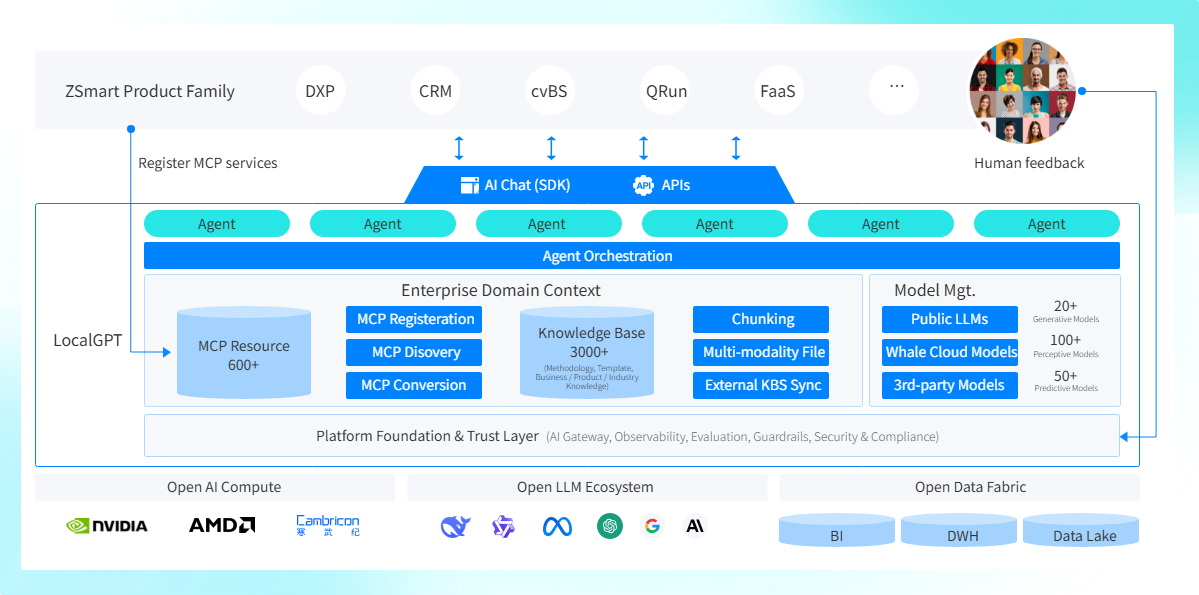
The company’s AI First strategy describes intelligence being embedded across the technology stack. LocalGPT is positioned as an AI business solution for telecom, supporting agent orchestration across telecom business scenarios, with enterprise data integration and private deployment capabilities. Embedded AI therefore creates an infrastructure question because intelligent workloads must coexist with established telecom applications.
At Morning Peak Demand Rises
A scheduler first needs operational signals. The company’s real time billing architecture offers a useful cloud native example. Its event driven microservice architecture can allocate resources according to business load, while Kubernetes is used to adjust processing resources. The system can also release resources when real time performance indicators show that redundant applications are no longer required.
For teams operating AI business solutions, the same scheduling principle starts with classifying workloads. A customer facing inference task may have different responsiveness requirements from offline analysis. A billing process may carry a different operational priority from model evaluation. Container orchestration supplies a technical mechanism, but operators still need policies defining which workloads scale immediately, wait, or surrender capacity.
The point is not to give AI permanent priority. Telecom environments contain mission critical workloads whose service requirements remain important when AI consumption grows. Resource policies should therefore consider workload purpose, utilization, latency requirements, and business priority together rather than treating all containers as interchangeable.
By Midday Accelerated Compute Becomes Scarce
AI changes the resource equation because some workloads can require GPUs or other accelerated computing resources. Whale Cloud’s cloud offerings include Local Public Cloud deployments in Saudi Arabia, while its broader AI and cloud portfolio supports AI platforms and computing resources. Its broader Cloud for Telcos framework also includes resource orchestration across edge, network, and cloud environments.
This is where Embedded AI makes scheduling more complex than increasing container counts. A cluster may have available CPU capacity while accelerator capacity remains constrained. Operators therefore need visibility into resource types and placement requirements as well as total utilization.
The official materials do not state that every LocalGPT deployment follows one GPU scheduling architecture. Deployment decisions depend on an operator’s infrastructure and application design. For AI business solutions, compute allocation should therefore reflect the actual model, inference pattern, data location, and service objective rather than a universal configuration.
Afternoon Traffic Changes the Schedule
Telecom demand does not remain constant. Billing cycles, customer activity, campaigns, service events, and network conditions can all alter resource consumption. The Cloud for Telcos portfolio supports public, private, and hybrid deployment and describes hybrid auto orchestration of services and resources across environments.
That flexibility becomes important as Embedded AI moves inside BSS, OSS, cloud, and digital platforms. The company describes its AI Inside approach as embedding intelligence across the stack rather than operating AI as an isolated layer.
Resource orchestration and AI governance should still remain distinct responsibilities. A container having sufficient capacity does not mean an AI agent should receive unrestricted access to data or business actions. Infrastructure determines whether a workload can run; permissions and application governance determine what that workload may do.
This distinction matters as AI agents become more deeply integrated into telecom processes. Capacity can scale automatically, but access policies, tool permissions, and operational controls should remain explicit.
Evening Capacity Should Contract Again
Efficient scheduling is also about deciding when resources can stop. The Kubernetes based billing example demonstrates this principle by releasing redundant applications according to real time performance indicators. Cloud native efficiency depends on contraction as well as expansion.
Operators can apply this logic carefully when scheduling suitable AI workloads. Some analytical or development tasks may tolerate delayed execution, while customer facing applications may require available capacity to maintain responsiveness. Scheduling should therefore come from measured workload behavior instead of assumptions that every AI process has identical requirements.
Whale Cloud also positions its cloud strategy around elasticity, hybrid resource management, and data driven operations. Its Cloud for Telcos solution specifically describes cloud native infrastructure, lifecycle automation, and multi environment resource orchestration as elements of telecom digital transformation.
Overnight Metrics Rewrite the Next Schedule
A resource schedule should evolve from operating evidence. CPU and GPU utilization reveal part of the story, but application teams also need information about response times, queues, failed tasks, availability, and the business processes affected by scaling decisions.
This makes observability important for Embedded AI. Operators can compare predicted demand with actual workload behavior, adjust thresholds, and protect critical telecom processes when AI demand rises unexpectedly. Resource optimization then becomes a repeated operating cycle rather than a one-ime capacity plan.
Whale Cloud positions LocalGPT within its AI portfolio, while its cloud portfolio provides cloud-native infrastructure, hybrid resource orchestration, and scalable computing capabilities. These capabilities illustrate why infrastructure scheduling and embedded intelligence increasingly need to be considered together.
The objective is not maximum container utilization at every moment. A stronger operating model balances service priority, accelerator availability, elasticity, data location, and governance. When Embedded AI is supported by disciplined resource scheduling, telecom operators can move intelligent software from isolated pilots toward repeatable production workloads without treating infrastructure capacity as unlimited.
