Lighting uniformity is a critical consideration when upgrading industrial, warehouse, and retail environments. Uneven illumination can create dark areas, excessive contrast, and glare, making visual tasks more difficult and reducing the effectiveness of a lighting investment. A well-designed system should therefore consider not only total lumen output but also optics, mounting arrangement, spacing, and the geometry of the space. For retrofit projects, modular LED light panels can provide additional flexibility when these factors need to be balanced.
Start with the Actual Lighting Requirements
Uniformity should be evaluated against the activities performed in a space rather than treated as a standalone product specification. EN 12464-1 addresses illuminance, uniformity, glare, and color rendering according to different tasks and areas. For example, storage and rack areas can have different requirements depending on whether aisles are continuously occupied, whether workers handle goods, and where visual tasks take place.
Before selecting equipment, lighting designers should identify the working plane, ceiling height, aisle dimensions, rack arrangement, and areas requiring higher illumination. A photometric calculation can then determine fixture quantity, spacing, mounting position, and expected uniformity. This approach is more reliable than simply selecting high-output luminaires and assuming that more light will automatically produce better coverage.
Match Optics to the Space
Optical distribution has a direct influence on how evenly light reaches the intended surfaces. Wide or medium beam patterns can generally help distribute light across open areas, while narrower optics can be more suitable for tall storage aisles where illumination needs to reach vertical rack faces. Signify’s industrial lighting guidance similarly recommends selecting beam characteristics according to aisle dimensions and mounting height.
The objective is to avoid excessive overlap in some locations and insufficient illumination in others. A lighting layout should therefore consider both horizontal and vertical surfaces. In high-bay warehouses, for example, light directed toward shelving can be more useful than simply increasing the downward lumen output. Optical choices should be validated through photometric software before installation.
Use Modular LED Light Panels for Greater Layout Flexibility
A modular approach can make uniformity easier to maintain when the lighting arrangement must adapt to an existing infrastructure. A replaceable LED module can allow the optical or lighting component to be serviced or changed without treating the entire lighting installation as a single fixed unit, depending on the system architecture.
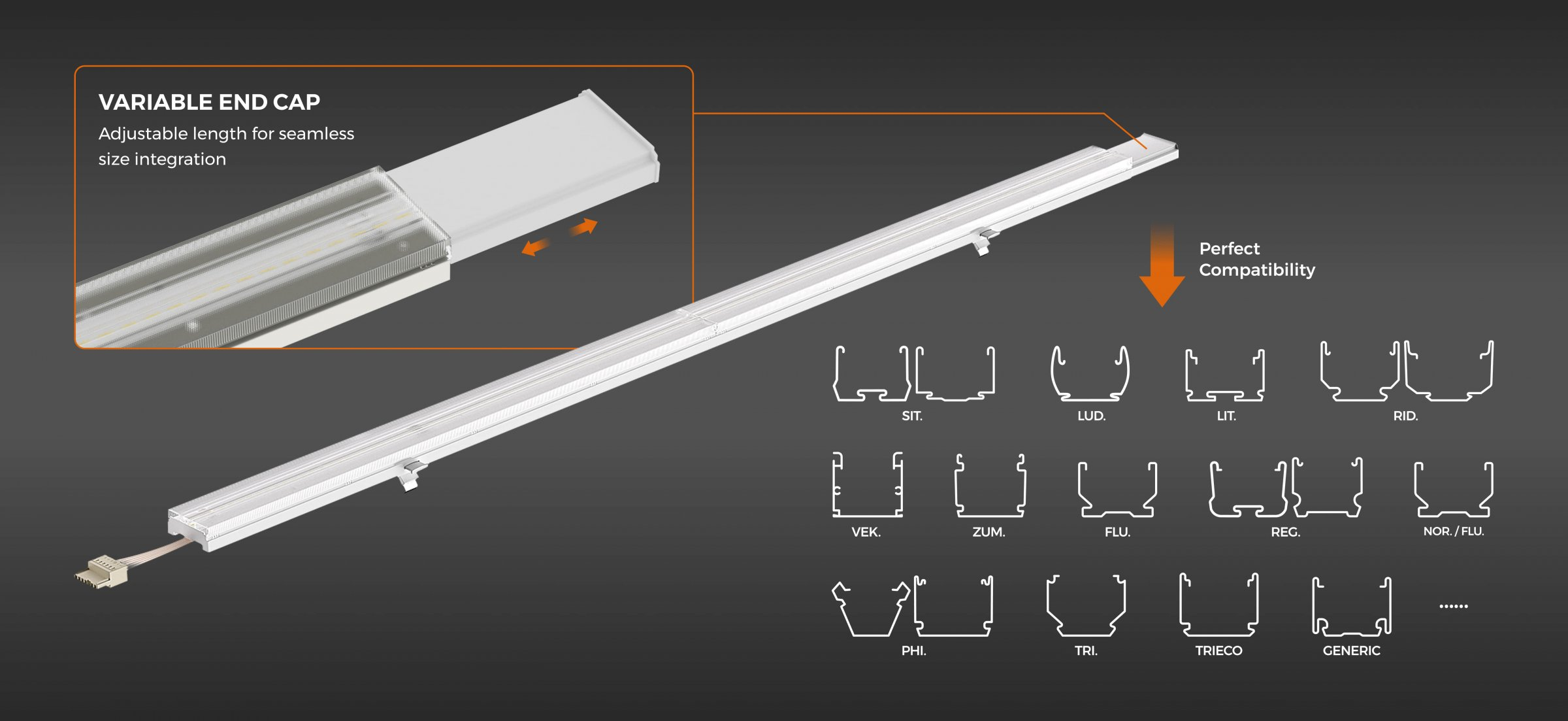
TRIECO’s DREAMUNI is designed for LED trunking retrofit and system renewal, particularly where the original trunking circuit is unusable. Its modules use an interlinked power connection and are compatible with more than 30 types of mainstream European trunking rails. The design supports installation without structural modifications, trunking replacement, or rewiring.
For contractors and facility operators, this type of compatibility can simplify retrofit planning. Rather than forcing the lighting layout to conform to a completely new infrastructure, the system can work around existing building conditions while allowing lighting positions to be organized according to the required coverage.
Balance Lumen Output with Distribution
High luminous flux is useful, but it should not be considered independently from optical performance. TRIECO’s DREAMUNI specification lists a luminous flux of up to 13,500 lm and luminous efficacy of 180 lm/W. It also specifies CRI>80 and UGR<16, providing a combination of output, efficiency, color rendering, and glare control for appropriate applications.
These specifications can support a lighting design, but the final uniformity still depends on fixture spacing, mounting height, room reflectance, and optical distribution. A 13,500-lumen luminaire positioned too far from neighboring fixtures may still produce uneven illumination. Conversely, excessive fixture density can increase energy use without delivering proportional benefits.
Control Glare Alongside Uniformity
Uniformity is not simply about avoiding dark spots. Excessively bright sources can also create uncomfortable contrasts and visual distractions. Unified Glare Rating (UGR) is used to evaluate discomfort glare, making it another parameter worth reviewing during project design.
DREAMUNI specifies UGR<16, described by TRIECO as an ultra-low-glare optical design. For commercial lighting projects, such a specification can be useful when glare control is part of the project brief. However, UGR is influenced by the room, luminaire arrangement, observer position, and surrounding surfaces, so the stated luminaire value should not replace a complete lighting calculation.
Plan for Future Changes and Maintenance
Warehouse and industrial layouts frequently change as storage systems, equipment, and workflows are modified. A rigid lighting arrangement may become less effective when aisles move or shelving heights change. Modular LED light panels and compatible trunking systems can provide a practical foundation for future adjustments. This is especially true when the product architecture supports repositioning or component replacement.
TRIECO positions its lighting portfolio around retrofit applications in industrial, retail, and office environments. Its current manufacturing and project capabilities include a 10,000+ m² manufacturing base, more than 500 lighting projects, and products supplied to over 99 countries and regions.
For facility managers, the value of modularity therefore extends beyond installation. A replaceable LED module can potentially simplify selected maintenance or upgrade tasks, while a compatible trunking infrastructure can reduce the disruption associated with future lighting changes. The exact maintenance benefits should always be confirmed against the selected system’s service design.
Build Uniformity into the Whole Lighting Strategy
Optimizing uniformity requires more than choosing powerful luminaires. Project teams should begin with task requirements, calculate appropriate illuminance and uniformity targets, select optics according to the building geometry, and verify the proposed layout using reliable photometric data. Glare, color rendering, energy efficiency, and future maintenance should then be evaluated as part of the same decision.
For retrofit projects, modular LED light panels can offer an additional layer of flexibility when supported by a suitable trunking infrastructure. TRIECO‘s DREAMUNI combines 180 lm/W efficacy, 13,500 lm luminous flux, CRI>80, UGR<16, and compatibility with more than 30 mainstream European trunking rails. The right solution, however, remains the one whose specifications and layout work together to deliver consistent illumination for the facility’s actual operational needs.
