Finding the right fit across different footwear labels often feels unpredictable due to variations in manufacturing lasts, regional sizing scales, and upper materials. A single numerical size rarely yields the same internal volume across distinct cycling manufacturers. Conducting a thorough cycling shoe size comparison before purchasing helps riders avoid hot spots, foot numbness, and premature joint fatigue.
Selecting performance footwear designed by Santic requires evaluating exact foot measurements rather than assuming standard sneaker sizing translates directly. Understanding why sizing discrepancies exist across the industry empowers cyclists to choose models that provide stable power transfer without restricting circulation.
The Role of Last Design in Shoe Sizing Differences
Footwear manufacturing begins with a three-dimensional wooden or plastic mold known as a last. Every brand sculpts its proprietary lasts based on specific regional foot data, target rider demographics, and intended discipline. Consequently, two shoes labeled with the same European size can feature entirely different toe box curvature, instep height, and heel cup volume.
Varying last geometries explain why a shoe might feel spacious in the forefoot yet tight across the midfoot. Manufacturers catering to endurance riders often design slightly roomier forefoot lasts to accommodate swelling over long hours. Race-focused models utilize narrower lasts designed to minimize internal movement, creating noticeable sizing variance between models.
Regional Measurement Systems and Size Conversion Distortions
European, American, and British sizing systems use different mathematical increments to mark shoe lengths. European sizes use the Paris Point system, where each size increment equals two-thirds of a centimeter, whereas US and UK systems rely on fractional inch scales. Translating between these systems introduces rounding discrepancies that alter fit accuracy.
Conversion tables provided by manufacturers often round millimeter measurements to the nearest whole regional size. A rider who fits neatly into a European size forty-two might find that the equivalent US conversion spans across two different fit profiles depending on brand rounding preferences. Metric foot length remains the only universal benchmark across global sizing charts.
Impact of Sole Material Rigidity on Perceived Sizing
Street shoes and casual sneakers feature flexible outsoles that bend and stretch around the foot during movement. Rigid cycling soles constructed from carbon fiber or reinforced nylon composites do not yield or break in over time. Footwear that feels slightly snug in a flexible sneaker will feel restrictive and painful on an unyielding cycling platform.
Because stiff outsoles do not adapt to foot shape, riders often perceive stiff performance shoes as running smaller than traditional footwear. Choosing models with engineered platforms, such as those found in Santic footwear lineups, requires matching foot length precisely from day one. Uncompromising sole stiffness makes accurate initial sizing critical.
Upper Construction and Material Stretch Characteristics
Synthetic leather uppers, micro-perforated microfiber, and integrated mesh panels react differently to foot pressure. Natural leather relaxes over time, whereas engineered synthetic fabrics maintain their factory dimensions across seasons of use. Shoe uppers designed with minimal stretch retain their original shape, requiring exact sizing upon purchase.
Ventilation panels, protective overlays, and structural seams also dictate how uppers wrap around the instep. Heavy reinforcement layers reduce upper compliance, making the internal cavity feel tighter. Lightweight, highly perforated uppers yield slightly more under foot pressure, altering fit feel across different upper constructions.
Closure System Mechanics and Internal Volume Adjustment
Distributing clamping force evenly across the footbed relies heavily on the design of the closure system. Rotary dials, hook-and-loop straps, and laces alter internal volume in distinct ways. Single-dial setups tighten uniform sections of the upper, while dual-dial systems allow independent adjustment over the forefoot and instep.
Riders with high insteps may find certain closure layouts limit upper expansion, forcing them to select a larger size. Evaluating how closure hardware pulls upper panels together clarifies whether a shoe model accommodates unique foot profiles. Flexible closure adjustment helps fine-tune volume once the baseline sole length is selected.
Measuring Foot Length in Millimeters for Consistent Fit
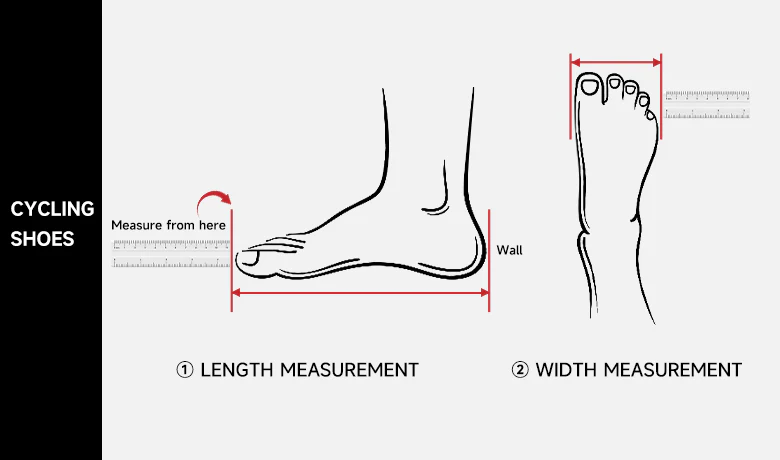
Relying on arbitrary regional numbers leads to inconsistent sizing outcomes when switching between cycling brands. Measuring foot length in millimeters creates a clear metric baseline that bypasses regional label confusion. Placing a sheet of paper against a flat wall, standing firmly, and marking the longest toe establishes an accurate physical dimension.
Comparing exact millimeter measurements against official brand sizing charts reveals how individual models line up with actual foot length. Evaluating an accurate cycling shoe size comparison chart prevents purchasing footwear with insufficient toe room. Metric tracking remains the most reliable method for online shoe selection.
Factoring in Forefoot Width and Foot Swelling
Foot length represents only one dimension of proper fit, making forefoot width equally critical for comfort. Standing while marking the widest points across the metatarsal joints reveals whether a standard or wide-fit last is required. Narrow lasts compress the forefoot, restricting blood flow during sustained pedaling.
Blood flow increases to the lower extremities during physical effort, causing feet to expand during multi-hour rides. Leaving three to five millimeters of clearance in front of the longest toe accommodates natural thermal expansion. Accounting for volume growth prevents painful hot spots from developing late in a ride.
Evaluating Cleat Slot Positioning Relative to Size
Cleat channel placement on sole bases corresponds directly to total shoe length and last geometry. Proper sizing positions the cleat mounting slots directly underneath or slightly behind the ball of the foot. Selecting an incorrect size shifts cleat adjustment channels forward or backward, compromising leg biomechanics.
Conclusion
Understanding why cycling shoe sizing varies between brands requires looking beyond surface-level size labels to examine last shapes, sole rigidity, and metric measurements. Measuring foot length and width precisely in millimeters eliminates conversion guesswork across international sizing charts. Utilizing a detailed cycling shoe size comparison enables riders to choose footwear that delivers secure heel retention, efficient power transfer, and long-distance comfort on every ride.
