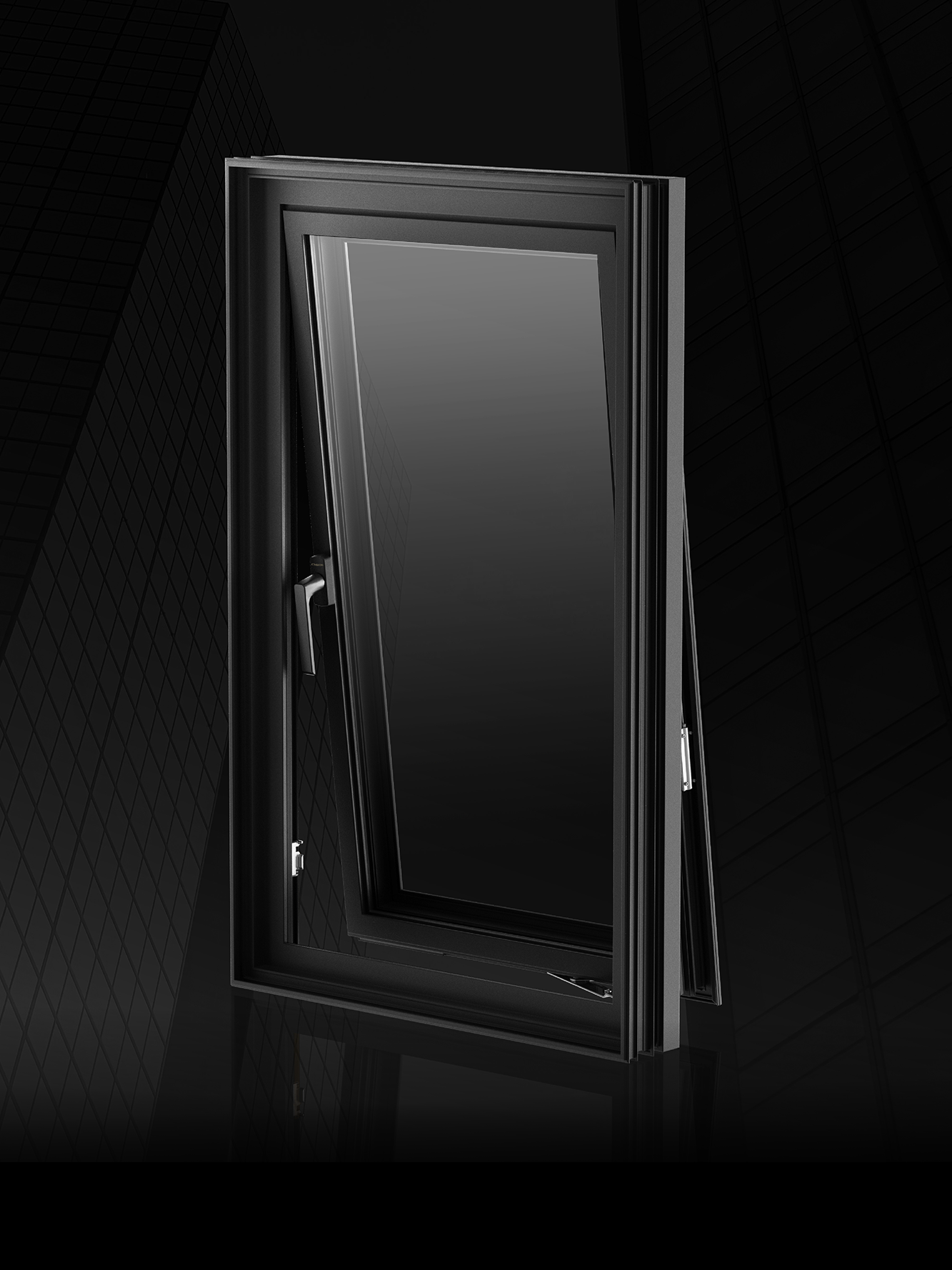
Top-hung configurations deliver protected, rain-safe ventilation at elevated positions. However, their outward-projecting sash geometry creates a compound safety hazard. Wind pressure acts continuously on a cantilevered panel. Operator error can trigger uncontrolled opening arcs. A single hardware failure at height risks catastrophic sash detachment. Standard casement hardware is not engineered to address these complex challenges.
The CMECH Outswing Casement & Awning hardware-system integrates a dual-suspension safety architecture specifically calibrated for these demanding applications. It delivers an 80 kg‑rated system‑level load‑bearing platform and features a counterbalance rope with 550 kg static‑load capacity (static rating, not working load). Incorporating anti‑derailment hinge hooks and an anti‑misoperation module, this engineered system greatly mitigates mechanical‑failure modes frequently encountered in high‑rise installations, subject to compliant profiles and professional fabrication.
Dual-Mode Kinematics for a Top Tung Awning Window
Understanding the functional distinction between outswing casement and top hung awning window operation informs proper specification. Full swing mode delivers a wide aperture for cleaning, egress, and maximum airflow. Conversely, the top-hinged tilt position creates a rain-protected ventilation gap. This gap remains secure even during unattended occupancy, delivering reliable air exchange for building occupants.
These two mechanical envelopes demand entirely different load-path strategies from the same hardware set. The transmission system reconfigures locking-force distribution between modes. In full swing, the multi-point lock engages jamb keeps along the entire perimeter. In tilt mode, the gear limiter and restricting stay collaborate to cap the opening angle securely.
Upper Hinge Anti-Derailment and 3D Adjustment
The double-baseplate upper hinge utilises a stainless‑steel load‑bearing arm up to 3.5 mm thick. It features an anti-derailment hook mechanism that grips the profile tighter as the sash weight increases. This design re‑imagines the top hung window hinge beyond a simple pivot, delivering progressively secure hook‑engagement that acts conceptually like a progressive clamp. When paired with compliant profiles and professional fabrication, it improves resistance against static dead‑load and dynamic wind uplift loads.
Furthermore, the hinge platform supports comprehensive 3D indoor adjustment. This capability allows installers to correct frame-to-sash alignment safely after the panel is hung. Such accessibility is critical for a top hung window where elevation and exterior access constraints make field precision difficult. Proper alignment prevents accelerated gasket wear and maintains the intended rain-shedding geometry.
Counterbalance Ropes and Secondary Sag Prevention
The physics of outward projection inherently risk structural sag over time. As the sash bottom projects outward, the upper hinge pair carries the full cantilever moment. Over time, this stress produces pivot-bore elongation and progressive bottom-edge droop. Such mechanical fatigue ultimately destroys seal compression and creates viable water-ingress pathways along the window perimeter.
To counteract this, the engineered counterbalance rope incorporates a specially shaped spring within its tensioner. This component improves load‑handling capability and prevents secondary sash sagging. The steel rope delivers a 550 kg static‑load capacity (static test rating, not normal‑operation load). Serving as independent redundancy, this assembly helps restrain the sash and mitigates fall risks should the primary hinge pair encounter unforeseen fastener fatigue under extreme‑weather conditions, subject to robust end‑fixings, compliant profiles and professional fabrication.
Anti-Misoperation Modules and Dual-Suspension Safety
Operational risks increase when users force handles beyond their intended arc. This action can jam the transmission, deform the corner drive, or accidentally release the tilt limiter. Such misuse converts a controlled top hung awning window ventilation gap into an uncontrolled swing. This exposes the heavy sash to severe impact or detachment forces.
The CMECH anti-misoperation module addresses this by utilizing dual corner drives paired with a double-bump keeper. An internal U-shaped flat spring delivers strong rebound force, preventing lever jamming and resetting the mechanism to neutral. The dual-suspension architecture distributes the sash load across two independent engagement points, ensuring no single-component failure triggers sudden collapse.
Restricting Stays and Wind Resistance at the Free Edge
The bottom free edge of a top hung awning window remains highly vulnerable to wind-slam dynamics. Gust pressure concentrates at the cantilevered extremity, generating a powerful closing torque. This force can shatter glass or deform frames if the stay hardware lacks impact resistance. Proper restraint hardware is vital for high-rise commercial and residential applications.
The advanced restricting stays are available in 6-inch, 8-inch, and 9-inch sizes, featuring a barbed clamp structure that bites securely into the profile. Combined with the lower hinge’s gear-type limiter anchored by three screws, this setup resists wind-slam events. It prevents sudden closure in storm conditions while maintaining a fixed, safe ventilation gap.
Multi-Point Locking and Seal Compression Integrity
Coordinated multi-point locking significantly improves water tightness, air tightness, and overall wind-pressure resistance. The robust corner drive employs a dual-fixation structure reinforced by a lateral brace that stops transmission-rod sag. This ensures all lock points engage simultaneously. It compresses the gasket line with uniform pressure regardless of whether the sash is in swing or tilt position.
By distributing locking pressure strategically, the hardware helps minimise localized structural distortion within the frame. Subject to compliant profiles and professional fabrication, the internal mechanisms accommodate sash dimensions ranging from 425 mm to 800 mm in width and 670 mm to 2 000 mm in height. This precision enables building professionals to specify large, uninterrupted architectural glass units without compromising operational security or weather‑performance.
Material Specifications for a Top Hung Window
Long-term structural resilience depends on premium‑grade materials for all active components. Primary load‑bearing parts are manufactured from durable 304 stainless steel. Engineered for heavy‑duty commercial deployment, the friction‑hinge mechanisms are tested to a minimum of 30 000 open‑and‑close cycles. This rigorous validation supports decades of daily operation under demanding exterior‑site conditions.
For multi-unit developments, specifying this standardized 80 kg-rated CMECH hardware family across building openings streamlines procurement workflows. It ensures consistent tactile operation for end-users across the property. In addition, it offers a unified technical‑support reference for high‑rise installation crews, improving construction‑site efficiency and lowering long‑term maintenance liabilities for property-management teams.
All hardware specifications, performance data and material parameters are sourced from CMECH official product manuals and certified test reports.
