On a plant floor, a demonstration gives a buyer a chance to watch a technician read the screen, recognize an alarm, and retrieve the data. The useful comparisons in combustible gas detection are the basis of the flammability reading, the settings that govern alarms, the purpose of each additional channel, and the way a shift hands off information.
A demonstration becomes more informative once each observation has a corresponding specification. A clear screen does little to explain what a percentage represents, and an audible signal gives little detail about the setting that produced it. The evaluation starts by establishing what the flammability channel measures before the team scores other features.
Read the Flammability Specification One Column at a Time
Range, resolution, accuracy, and response time describe different aspects of measurement. The range gives the endpoints of the scale. Resolution sets the size of the steps between them, while accuracy describes how closely the indicated value agrees with a reference under specified conditions. Response time addresses how quickly the reading changes after exposure.
The reference fuel sets the percent LEL scale on a combustible gas channel. Two instruments calibrated against different fuels can display the same percentage for different conditions. A quotation for a 6 gas monitor can make its scale interpretable by recording the calibration gas, the displayed unit, and the measurement range together.
Procurement records gain clarity when each specification carries its own test conditions. Response times are easier to compare when both refer to the same response criterion and relevant gas. Where the demonstration includes a sampling line, the delay through that line can be noted separately from the response figure quoted for the sensor.
Tie Alarm Settings to the Configuration
An alarm point is a setting applied to a measurement, and its significance depends on the gas and scale used for that channel. A comparison of the calibration options for a 6 gas monitor can identify the test gas, supported calibration points, and settings that will be used on the delivered instrument.
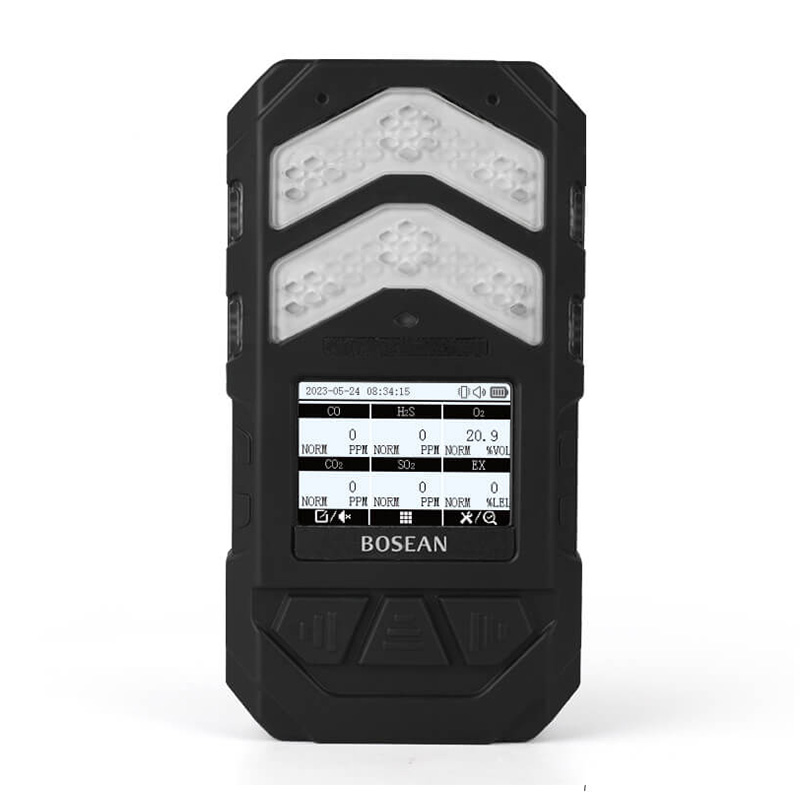
One Bosean K-600N configuration specifies a flammability range of 0 to 100% LEL in increments of 1% LEL, with low and high alarm points of 20% and 50% LEL. The model supports calibration at up to five points. The example settings describe that configuration, while the settings for a particular site depend on its own assessment and operating requirements.
The demonstration can show which indication accompanies an alarm event and how clearly the channel is identified on the screen. Sound, light, vibration, and the display give observers several ways to recognize the event. Recording the applied settings beside those observations makes the demonstration a record of a particular setup that can be checked against delivery.
Give the Remaining Channels a Job
An instrument may be purchased for a flammability task even when the same work brings other gases into the assessment. Each additional channel earns a place by answering a defined question about the atmosphere. The gas list can be tied to a particular job or location, so procurement knows which of the offered channels it actually needs.
The other channels in the six-channel Bosean example measure oxygen, hydrogen sulfide, carbon monoxide, carbon dioxide, and nitrogen dioxide. The carbon dioxide channel spans 0 to 5% by volume, and the nitrogen dioxide channel spans 0 to 20 ppm. The unit and gas label give each reading its meaning on a screen that displays several measurements at once.
Putting the combustible gas channel alongside oxygen is useful where the job calls for both measurements. The toxic channels in the same configuration likewise describe specific gases, and their stated ranges can be compared with the needs of the operation. That mapping gives the evaluator a reason to inspect the way multiple readings are presented and recorded.
Follow the Reading Through the Shift
A shift handoff includes both what the operator can see at the time and what a colleague can retrieve later. An evaluation of data access on a 6 gas monitor can show how a reading is identified on screen and which steps are needed to bring the instrument data to a computer.
The Bosean K-600N samples by natural diffusion and displays up to six gases simultaneously on a screen with a resolution of 240 × 160 pixels. Its Type-C interface supports computer data access. The device also has three buttons and supports unit switching. During a demonstration those features can be assessed through routine actions such as finding a channel and retrieving its data.
Specifying a data connection still leaves questions about the software and its place in the work routine. The demonstration can confirm what the delivered software lets the team retrieve, whether the gas and measurement unit remain identifiable afterward, and whether the necessary computer is available at shift change. Those answers show which features a site can use in its existing routine.
A comparison sheet can bring together the reading basis, alarm setup, required channels, and steps for handling data. Each entry can point to a specification or an observed action. A second shift then has a concrete basis for checking what the delivered monitor does in the same task.
SEO Title: Combustible Gas Detection: What Buyers Compare
Meta Description: Compare combustible gas monitors by reading scale, alarm settings, additional gas channels and how crews retrieve readings at shift handover.
