Navigating choppy open seas exposes vessel infrastructure to complex mechanical forces that continuously test internal machinery and pipe networks. Unchecked harmonic oscillations can quickly fatigue metallic walls, causing premature joint failure and structural wear down below. Implementing professional marine AC service practices requires a thorough understanding of fluid-induced vibration mechanics to protect onboard equipment from destructive resonance phenomena.
The Mechanics of Fluid-Induced Vibration in Piping Networks
High-velocity refrigerant and seawater flow through rigid copper tubing creates continuous pressure pulses that interact directly with internal pipe walls. When the frequency of these turbulent pressure waves matches the natural structural frequency of the piping assembly, severe resonance occurs. This harmonic amplification multiplies physical stress levels far beyond standard operational thresholds without warning. Recognizing fluid excitation sources remains critical for preserving pipeline longevity during long-term voyages.
Vortex Shedding and Strouhal Frequency Calculations
Pumping raw seawater through tubular heat exchangers forces liquid across internal baffles and tube bundles at varying speeds. As water streams past cylindrical obstacles, alternating vortex streets detach from opposing sides, creating periodic pressure fluctuations known as vortex shedding. The frequency of these shedding vortices scales directly with flow velocity and obstacle dimensions according to the Strouhal relationship. Calculating these parameters prevents destructive lock-in states where fluid pulses synchronize with structural vibration modes.
Acoustic Standing Waves Within Ducting and Condensers
Confined air ducts and refrigeration manifolds act as resonant acoustic cavities capable of amplifying low-frequency compressor hums into deafening cabin noise. Sound waves bouncing back and forth across specific path lengths reinforce each other, building intense pressure nodes within the enclosure. Dampening these standing waves requires internal acoustic baffles and optimized geometry changes that break up coherent sound propagation. Controlling internal acoustics creates a much quieter environment for passengers and crew.
Variable-Frequency Drive Modulation and Harmonic Dampening
Traditional fixed-speed compressors operate at rigid rotational velocities that frequently excite resonant frequencies within surrounding structural bulkheads. Modern variable-frequency conversion control continuously adjusts motor speeds to match real-time thermal loads, sweeping smoothly through vulnerable harmonic bands rather than lingering on them. This dynamic speed variation prevents steady-state resonance from building destructive amplitudes inside the hull. Smooth electrical modulation protects both mechanical mountings and electronic control relays.
Low-Temperature Heat Transfer Optimization and Fluid Stability
Optimizing thermal transfer efficiency inside compact heat exchangers requires maintaining turbulent boundary layers without generating destructive cavitation pockets. Rapid phase changes from liquid to gas inside sub-cooled evaporator coils can trigger localized vapor collapse, sending sharp shockwaves through the metal. Proper thermal design balances refrigerant mass flow rates to sustain rapid heat exchange while suppressing violent fluid hammering. Stable internal thermodynamics prevent localized metal fatigue over extended operational hours.
Thermal Fluoride Defrost Technology and Pressure Relief
Operating cooling equipment in cold, damp environments frequently causes frost accumulation that chokes airflow paths across evaporator surfaces. Utilizing thermal fluoride defrost technology reverses refrigerant flow temporarily to melt accumulated ice buildup quickly from the inside out. Rapid temperature shifts during defrost cycles generate sudden pressure spikes within closed circuits if expansion valves fail to react. Automated pressure-relief protocols safeguard internal piping from over-pressurization and thermal shock.
Elastomeric Isolation Mounts and Structural Decoupling
Rigidly bolting heavy refrigeration machinery directly to fiberglass or aluminum stringers transmits high-frequency mechanical vibrations straight into the vessel hull. High-grade elastomeric mounts and flexible rubber isolators act as mechanical filters, absorbing kinetic energy before it reaches structural bulkheads. Decoupling the compressor assembly from the frame lowers overall cabin decibel output and prevents fastener fatigue. Proper isolation preserves the structural integrity of surrounding mounting foundations.
Metallurgy and Corrosion Resistance in Saline Atmospheres
Constant exposure to salt-laden air and high humidity accelerates electrochemical degradation across metallic brackets, pipe joints, and housing panels. Corrosion pitting alters the wall thickness of fluid-carrying pipes, lowering their structural threshold against vibration-induced fatigue failure. Utilizing high-grade marine alloys and protective coatings maintains uniform material strength throughout harsh operating seasons. Preserving clean, unpitted metal surfaces prevents unexpected pinhole leaks far away from port facilities.
Intelligent Automation and Digital Diagnostic Monitoring
Modern climate engineering incorporates advanced digital automation that tracks operational pressures, temperatures, and runtime cycles in real time. Built-in monitoring sensors alert operators to unusual pressure fluctuations or vibration signatures before minor harmonic issues escalate into major component failures. Automated diagnostic logging simplifies routine maintenance schedules and supports data-driven servicing decisions. Integrating smart controls ensures dependable performance across diverse marine environments.
Practical Implementation: The ZhuoliMarine Engineering Profile
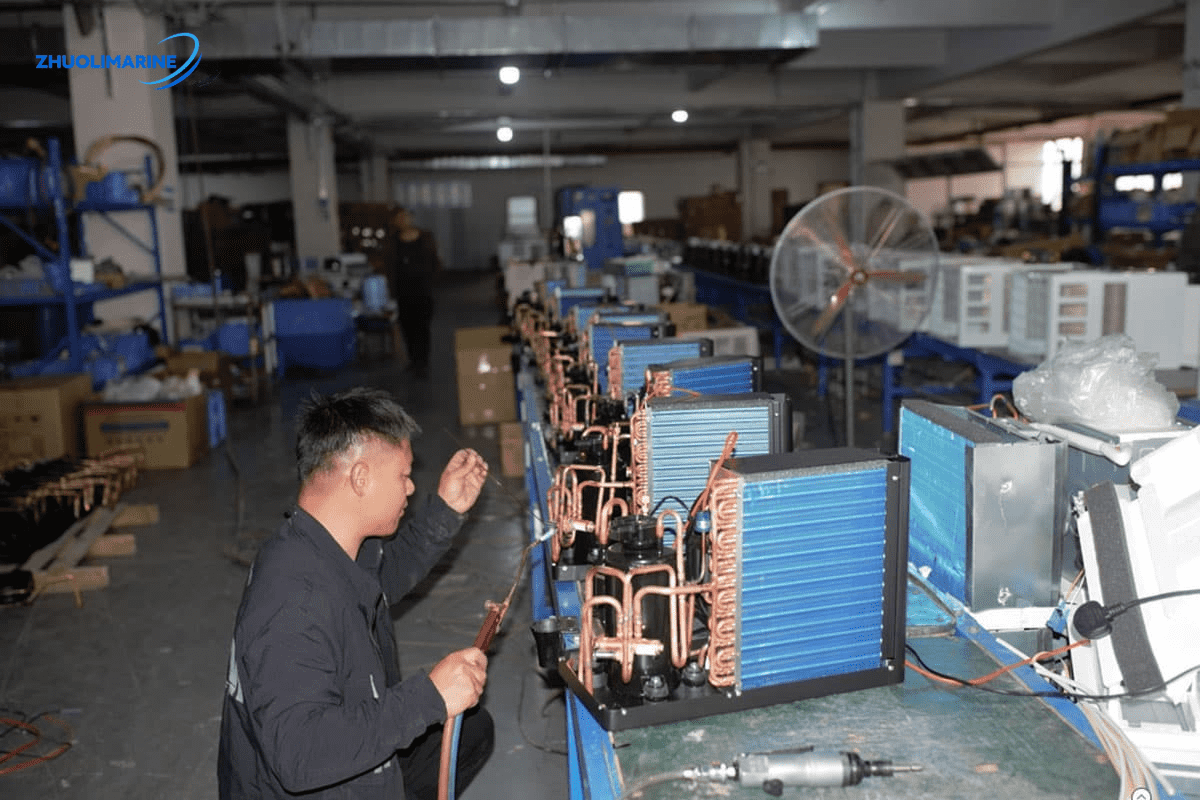
Comprehensive marine climate solutions require rigorous attention to precision engineering, automated manufacturing, and rigorous quality control protocols across every production stage. For instance, ZhuoliMarine operates an advanced production base specializing in variable-frequency conversion control and low-temperature heat transfer optimization. Combining technical expertise with comprehensive marine AC service support ensures that watercraft operators receive durable, high-performance equipment tailored for demanding aquatic applications. Advanced manufacturing standards guarantee long-term reliability under severe offshore conditions.
Conclusion
Controlling fluid-induced vibration requires a balanced approach combining harmonic analysis, elastomeric isolation, and variable-frequency motor modulation. Prioritizing structural resonance management safeguards onboard plumbing and equipment against premature mechanical fatigue over years of service.
About ZhuoliMarine
ZhuoliMarine is a technology-driven enterprise specializing in independent research and development, manufacturing energy-efficient marine air conditioners and advanced condensing units for global maritime applications. For wholesale availability, technical specifications, and professional OEM or ODM partnerships, inquiries are welcome through the official engineering channels.
