In the oils and fats industry, fractionation is a physical process that separates oils into different triglyceride fractions. It uses no chemical additives, generates no chemical by-products, incurs no oil loss, and produces no wastewater — making it a purely physical modification process.
The 800-ton-per-day RBD palm oil fractionation line Ocean built for the Ethiopia project is a comprehensive demonstration of its fractionation technology capabilities. Understanding the value of this production line requires an appreciation of the core technical aspects of the fractionation process.
The Physical Basis of Fractionation: Melting Point Differences in Triglycerides
Oils and fats are complex mixtures of numerous triglycerides. Different triglycerides have different carbon chain lengths and degrees of unsaturation, resulting in different melting points. Fractionation exploits this physical property: under precisely controlled temperature conditions, higher-melting-point triglycerides preferentially crystallize and precipitate out, allowing them to be separated from the lower-melting-point liquid fraction through solid-liquid separation.
For palm oil, this separation has significant commercial value. Fractionation yields products with different melting points — from 8°C super-olein to 55°C stearin — each with distinct application profiles: low-melting products suitable for salad oils and frying oils, medium-melting products suitable for margarine and shortening, and high-melting products suitable for cocoa butter substitutes and industrial fats.
Crystallization Control: The Technical Core of Fractionation
The success of fractionation depends critically on crystallization.
The crystallization process unfolds in roughly three stages: first, the oil is rapidly cooled to supersaturation to initiate the precipitation of high-melting components; second, slow cooling and agitation promote nucleation; and third, continued cooling to the target temperature allows crystal growth.
Three parameters are most critical across these stages:
Crystallization temperature must be precisely controlled. Temperatures that are too high prevent adequate crystallization of high-melting components; temperatures that are too low cause low-melting components to begin precipitating as well, compromising separation efficiency.
Cooling rate must follow a specific freezing crystallization curve. Different oil types and different target-melting-point products each require different cooling programmes.
Agitation speed is generally maintained at 10 to 13 revolutions per minute. Agitation that is too fast will break up the formed crystals, while agitation that is too slow will result in uneven crystallization.
Equipment Foundation: Crystallizers and Membrane Filter Presses
In Ocean’s palm oil fractionation line, the crystallizer is the core equipment. It features a precise temperature control system and a variable-frequency drive agitator that can automatically operate according to a pre-programmed cooling curve. For a large-scale 800-ton-per-day line, the coordination and batch management of multiple crystallizers is itself a systematic engineering challenge.
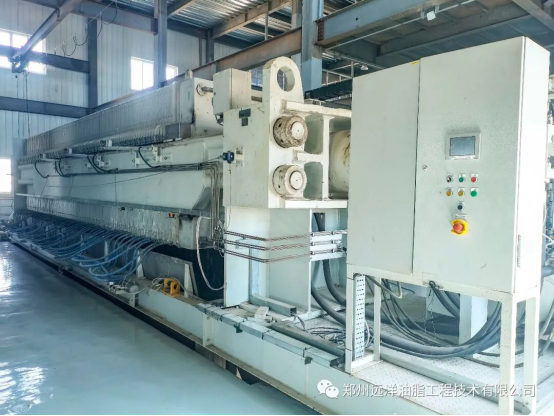
After crystallization is complete, the slurry containing solid fat crystals must be subjected to solid-liquid separation. Ocean uses a membrane filter press for this purpose. This equipment employs food-grade membranes and filter plates; after filtration, the membranes can be expanded to squeeze the filter cake further, recovering additional residual liquid oil and significantly increasing overall yield.
Product Value: The Market Significance of a Multi-Melting-Point System
The commercial value that palm oil fractionation can generate depends on the refinement of the product system. Ocean’s technology can produce multiple products with melting points ranging from 8°C to 55°C.
Each product has its own distinct market position and pricing. For example, 8°C and 10°C super-oleins remain clear and transparent at low temperatures, making them suitable for salad oils and cold-beverage ingredients; 24°C olein is the primary raw material for margarine production; and 33°C and above stearins are widely used in shortening and industrial fats.
A well-designed fractionation line is essentially a value-adding platform that converts a single raw material into a multi-product matrix. In the Ethiopia project, the 800-ton-per-day fractionation line, the 600-ton-per-day refining line, and the margarine/shortening production line form a complete value chain — crude oil enters the plant, and finished food ingredients leave, with value created at every step along the way.
Conclusion
The technical sophistication of palm oil fractionation lies not in the equipment itself, but in the precise understanding of crystallization kinetics and the systematic construction of a product quality system. The 800-ton-per-day fractionation line Ocean has demonstrated in the Ethiopia project is the engineered realization of many years of accumulated technical expertise.
As the food industry continues to fragment into ever more specialized segments, fractionation systems capable of producing multi-melting-point products are becoming a standard capability for integrated oil processing projects. Ocean’s fractionation technology is applicable to a wide range of oils and fats — palm oil, cottonseed oil, fish oil, lard, and more — and its technical framework is highly adaptable, allowing for customized designs based on different feedstock characteristics and product requirements.
